Electro Convulsive Therapy
At the Royal Cornhill Hospital in Aberdeen
The Tribunal
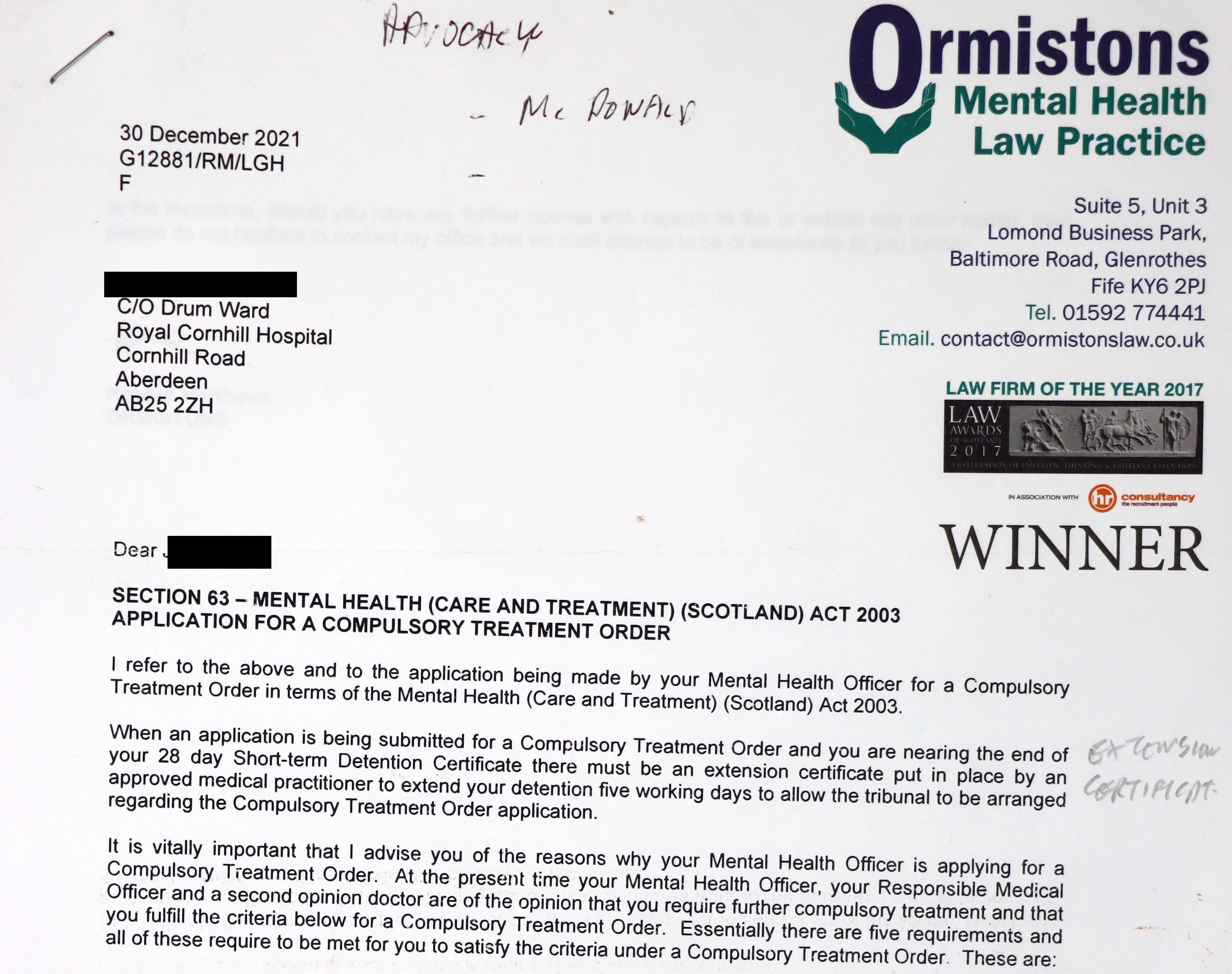
My Short Term Detention Order expired on the 26th December 2021 and the doctors decided to apply for a Compulsory Treatment Order to extend the detention and forced treatment with electroconvulsive therapy for up to another 6 months. The consultant who submitted the form, Dr Jane Murdoch, certified that I was incapable of instructing a solicitor. The second opinion doctor wasn’t independent as he was married to the ward doctor, Dr Hannah Badial, and I now know that he had a long telephone conversation with Dr Murdoch, so they coordinated their opinions instead of being independent of each other, as they should have been. He only had a very brief meeting with me. Both doctors certified that I was incapable of instructing a solicitor. This is chilling, because they were saying that I couldn’t have any legal representation at the tribunal and could be deprived of my liberty for another six months and forcibly treated with more electroshock.
Despite the two doctors certifying that I was incapable of doing so, I did instruct a solicitor who was provided by the advocacy service. I met him on 29th December 2021 and 5th January 2022. I was gobsmacked to see what had been written about me - the psychiatrists clearly didn’t expect me to see it - and I strongly objected to the order.
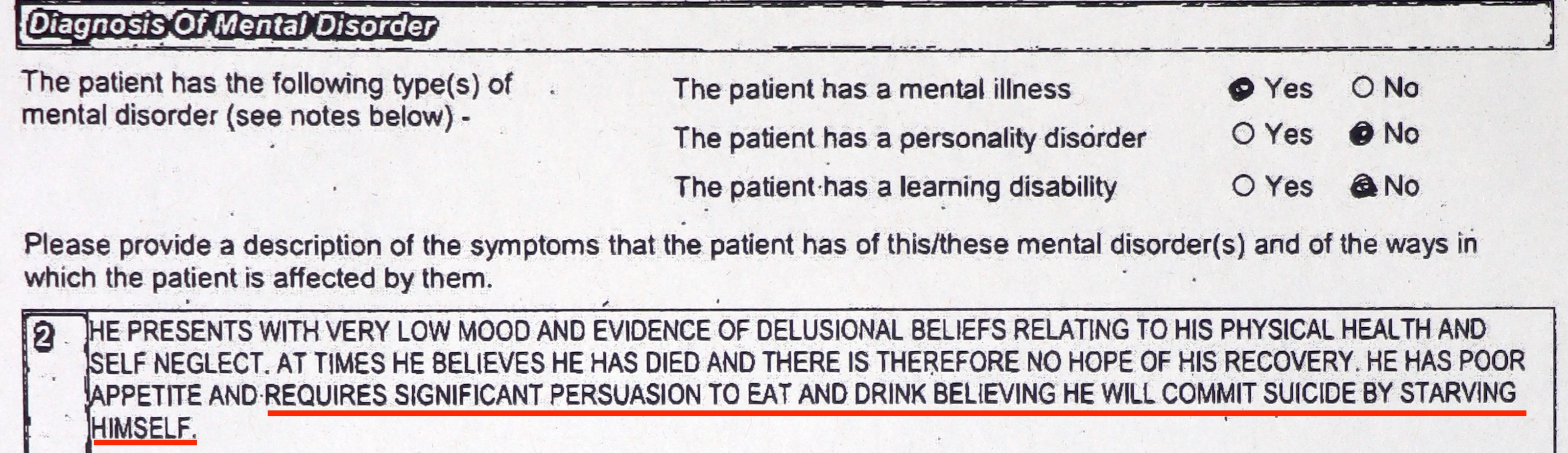
Dr Jane Murdoch wrote that I had delusional beliefs relating to my physical health, when I had been told that I had incurable cancer. She also wrote: “He has poor appetite and requires significant persuasion to eat and drink believing he will commit suicide by starving himself”.
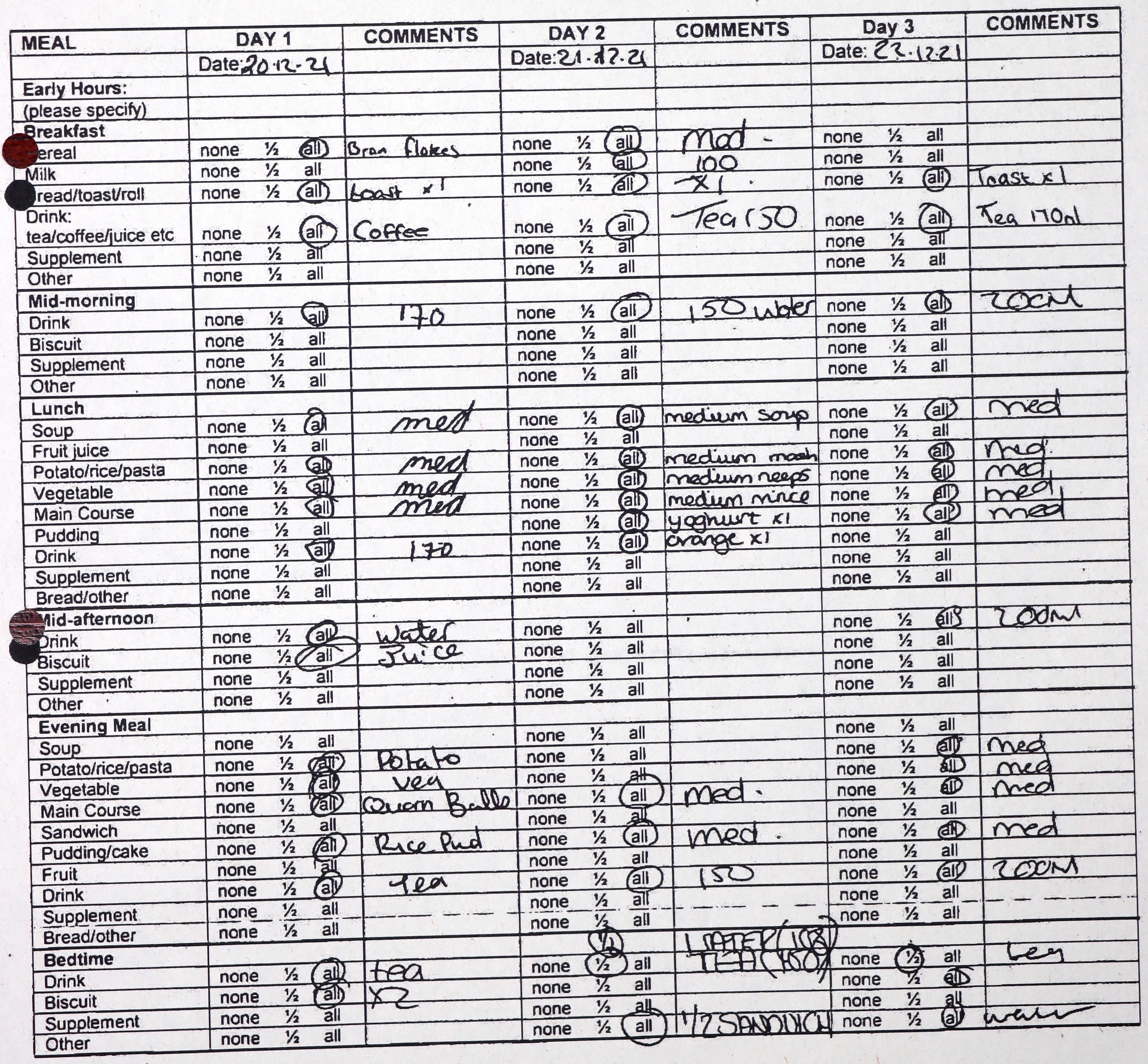
By this stage I was eating well. My notes include records of my food and drink intake, which completely contradict her and show that I had a good appetite. On the 21st December, the day when Dr Murdoch completed the form, the record of my food intake (above) shows that I had cereal and toast for breakfast, a 3-course lunch, an evening meal of an unspecified main course and a pudding. Before going to bed I had a sandwich. So the consultant in charge of my care deliberately lied when she said that I was starving myself.


She also stated on the form that I was “expressing a wish to commit unconscious suicide as he states his bowels are blocked and he will fill with faeces and die as a result”
This statement is farcical, but could have had very serious consequences for me. I now know that there are academic papers written on the causes of the constipation that often results from taking antipsychotics, particularly Olanzapine, because of their effect on the gut. I hadn’t had a shit since entering the hospital, and on 21st December, on the same day that Dr Murdoch completed the form, the ward GP administered suppositories and an enema and I ‘passed two large amounts of stool’. So Dr Murdoch lied about my constipation as well. Does she have similar contempt for her other elderly patients and assume that they will never see what she writes about them?
Victory
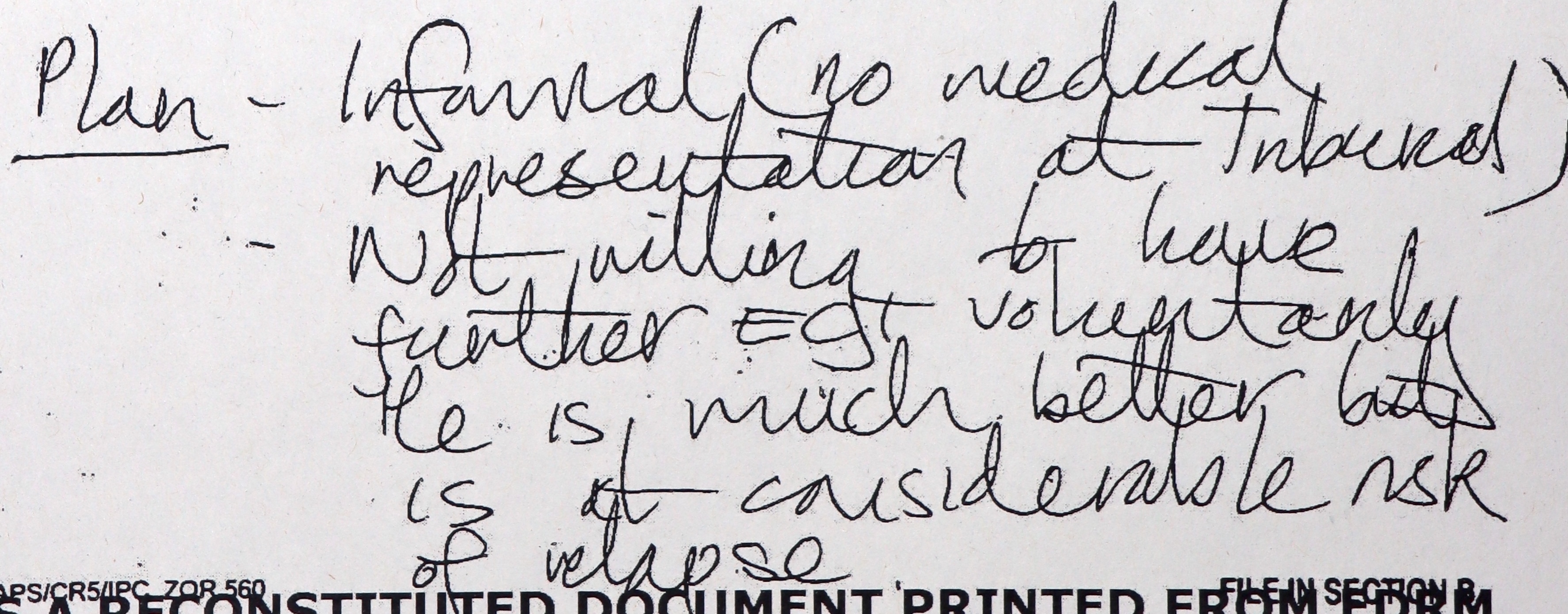
Luckily, the Tribunal took evidence from a nurse, as Dr Murdoch didn’t attend to try to justify her lies. It was held remotely on 6th January 2022. The Compulsory Treatment Order wasn’t granted despite the written evidence of two doctors, and I re-gained my liberty. I never saw Dr Murdoch again, despite her being my consultant.
My notes show a miraculous change in my mood, as there isn’t a single negative entry from the evening of 6th January onwards, when before then almost every entry noted my negative mood. Dr Hannah Badial made it clear that she wasn’t happy with the outcome of the Tribunal and noted that no medical staff were present (there was a nurse, but she didn’t seem to think that was adequate). She told me that there was a risk of relapse if I didn’t have two more sessions of ECT to complete the course. She was seriously deluded about this, but it does indicate that they are prepared to ignore all guidelines about ECT at the Royal Cornhill Hospital and treat it as a miracle cure for depression rather than a last resort treatment.
My situation immediately changed. I could go out of the ward once or twice a day to get exercise and fresh air. I walked a long way - as far as the centre of Aberdeen and the harbour, and to Old Aberdeen in the opposite direction. I got my wallet and bank cards back and found that I had £14,000 in my current account because my cousin had sold an expensive motorbike that I had owned. I bought new clothes and had a haircut. I bought a phone, a Macbook and a radio so that I could have contact with the outside world and start to sort out my finances. I decided to cut my losses and contacted an estate agent to put a property that I had been working on on the market. I bought books and ordered more online. I went to the art gallery and the local archives and had coffee and cake in many cafes.
It is this that allowed me to recover - the confinement, forced drugging and electroshock, lack of mental stimulation, lack of exercise and lack of contact with the outside world had made my depression and physical condition much much worse than it had been before I entered hospital. Why didn’t the doctors recognise this?
My notes become repetitive, as I went out of the ward every day and spent my time on the ward reading, listening to the radio or on my Macbook. I have no complaints about the nurses, who were friendly and helpful. The food was generally good, as was the hospital environment once I could escape through the locked ward door. I feel sorry for my fellow patients, shuffling between their bed space and the dining room and television, their days punctuated by the drugs trolley at breakfast and bed time, as mine were when in hospital.
The Cancer
I still believed that my terminal cancer meant that could not expect to live long and that my health would get gradually worse. On 31st January I had an appointment at the Aberdeen Royal Infirmary and met my Oncologist for the first time. I found out that I did have an aggressive cancer that had spread beyond the prostate. However, it had not spread to my bones, as I was told in Lancaster, only to some lymph nodes. This was serious and incurable, but with the addition of the drug Aberaterone and a course of radiotherapy there was a good chance of extending my life for a few more years. This was the first time anyone had told me this, and it seem incredible that I had to wait four months to find out that I had the prospect of a relatively normal life rather than increasing ill health and early death.
The Drugs
Dr Hannah Badial had told me absolutely nothing about the drugs that I was being made to take. She did not tell me their names, she did not tell me when she increased the doses, she did not warn me of the side effects. She did mention Olanzapine when I complained about my hands shaking all the time and my vision being blurred, but didn’t tell me anything about it.
On 16 January 2022 I asked a nurse to tell me the names of the drugs that I was being given. By that time I has a MacBook and could Google them from my hospital bed. When I was eventually discharged Dr Hannah Badial had still not told me anything about the drugs. It seems unbelievable to me that as a voluntary patient in an NHS hospital I had to ask a nurse to tell me about the drugs that I was being made to take and had to find out about them by Googling from my hospital bed. This seems to be indicative of the attitudes of the doctors who treated me, probably because they are specialists in the psychiatry of old age and expect their patients to be passive.
A few minutes before the transport to take me to the airport arrived I was handed a paper bag with boxes of pills from the pharmacy, still with absolutely no information from Dr Hannah Badial about what the drugs were, how to take them and how long to take them for.
When I got back home I opened the bag and found three boxes of pills. My strong instinct was not to take them, and this turned out to be an excellent decision. This was partly because no doctor had told me anything about the tablets, why I should take them and when to stop taking them - all I knew about them was from Google after I had asked a nurse for their names. I believe that it is medical negligence not to tell a patient about the life-changing effects of these drugs, the side effects and how to withdraw from them safely. I have since found that there are over 16,000 Facebook groups for people trying to withdraw from Sertraline and Mirtazapine and trying to cope with their side effects. I also hated the drugged feeling of being slightly stoned all the time and not being able to feel my emotions fully. I still have the tablets as a souvenir of my involuntary drugging, all unused. Mirtazapine and Sertraline were still at the maximum dose, 30mg and 200mg, with absolutely no information about how to safely reduce them. Olanzapine had been reduced to half the maximum dose, presumably because of my continued complaints about shaking hands and blurred eyesight.
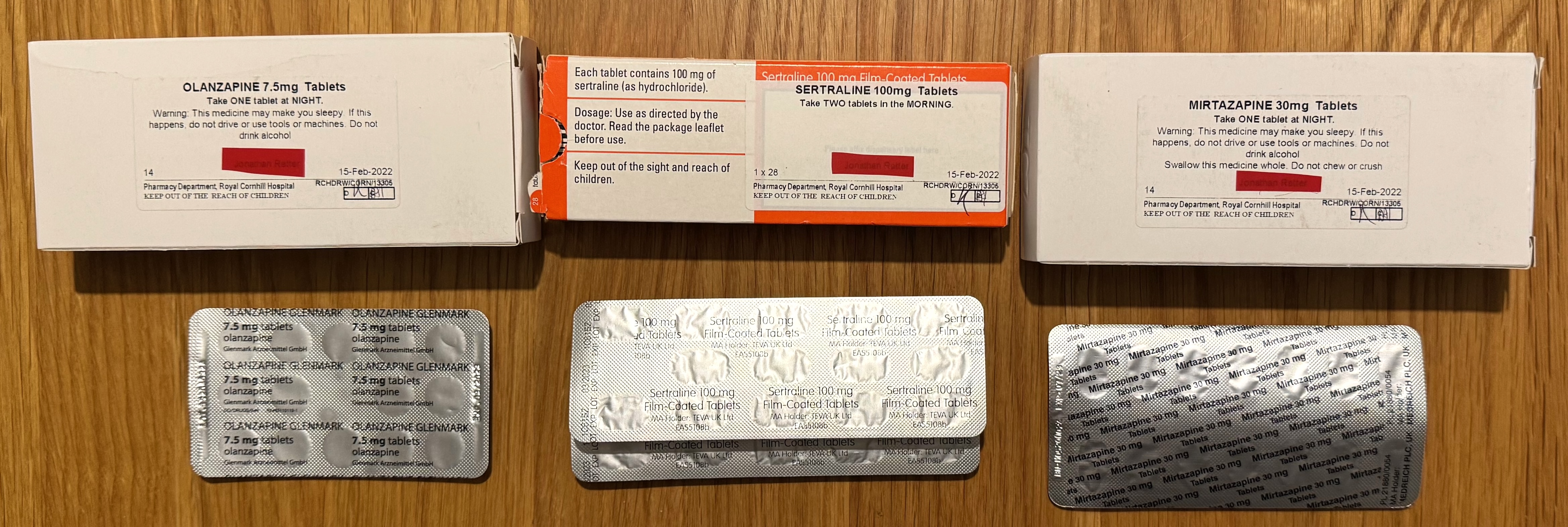
I was lucky in not suffering any ill effects of abruptly stopping the drugs. My depression had run its course as I came to terms with my diagnosis on my own despite the brutal treatment with drugs and electroshock. Instead of any noticeable withdrawal symptoms or any relapse of depression I actually felt much better - more clear-headed and less emotionally blunted and indifferent. I spent the next few weeks traveling. I am self-employed and started working again. I was back to normal and, apart from some close friends, no one had noticed that I had been absent for a few months.
Dr Marlies Jensen should never have loaded me with such powerful drugs in Lerwick, should never have started me on antipsychotics and should never have recklessly increased the doses so suddenly. The efficacy of antidepressant and antipsychotic drugs and their potentially devastating side effects is a highly controversial subject. From what I have read it seems that here is little sound evidence that they are effective except in very limited circumstances, and a lot of evidence for the harm that they cause - but that is a whole other topic.
I was very depressed, but I was falsely labelled as psychotic and it was frightening to experience drugs that made it impossible to think and express myself clearly and just made me much more depressed and apathetic.
When I got to Aberdeen the fundamental causes of my depression were never addressed or even discussed. It was treated as if it was a physical disease and any non-compliance and expressions of my low mood were symptoms to be treated with drugs. I only started to recover when I had the freedom to address some of the causes myself. Unlike other branches of medicine, psychiatry has no scientific tests - just the opinion and prejudices of a doctor after speaking to a patient, and just more and more drugs followed by electroshock.
The Doctors
Why did Dr Marlies Jenson, the consultant psychiatrist in Lerwick, give me so many drugs over such a short period, when I was very depressed but never psychotic and just asked to be taken to A & E because of my temporary loss of vision? Particularly Olanzapine, which is a nasty drug. They just reduced me to a zombie-like state which, together with the unexpected incarceration, made me completely despairing of any future and so physically frail that I needed help to get dressed and to walk. When I arrived at the Royal Cornhill Hospital the doctors there did not recognise that the drugs had made my condition much worse.
It is astounding is that the doctors responsible for my care lied on the official forms authorising forced treatment, in the expectation that I would never be able to see what they wrote about me or to challenge them. Perhaps this is how they normally treat their ‘old age’ patients. Dr Hannah Badial lied on the form requesting a second opinion for ECT, tripling the time that I had actually been unwell, not mentioning that I had been treated with drugs for less than two weeks, saying that I was refusing to eat or drink or to take medication when this wasn’t entirely true, and saying that, as a Stage 4 cancer sufferer, I had nihilistic delusions. Much worse, the second opinion doctor authorising ECT, Dr David Rooke, blatantly lied on the official form that he filled in, saying that he had examined and consulted me, which he was legally obliged to do, when he hadn’t. This is serious professional misconduct.
Dr Jane Murdoch, the consultant, lied on the form that she submitted to the Tribunal, saying that I was trying to commit suicide by starving myself, on the same day that I had attended all meals in the dining room and had breakfast, a 3-course lunch, a 2-course evening meal, and a sandwich supper. She also made the ludicrous claim that I wanted to commit unconscious suicide by filling with faeces and dying as a result, also on the same day that the ward GP took my complaints of constipation more seriously at last and gave me suppositories and an enema that produced results. After I won my liberty at the tribunal Dr Murdoch avoided seeing me again, despite supposedly being the consultant in charge of my care.
Anyone visiting Drum Ward and meeting Dr Hannah Badial would think that it provided a caring environment, which it did as far as the nursing was concerned. She was a middle aged lady who dressed all in black and had waist-length hair and a special sympathetic voice for talking to patients. What wouldn’t be apparent is her arrogance in using forced drugging and electroshock with an almost evangelical belief in her right to do so without telling her patients anything, based on her unscientific assessment of their mood. I feel sorry for my fellow patients swallowing their pills morning and night and shuffling between their bed spaces and the dining room every day. Their relatives and any inspectors from the Mental Welfare Commission for Scotland might see the environment provided by the nurses and hospital and find no reason to challenge the care being provided.
I feel hatred towards the doctors, particularly of Dr Hannah Badial, for what she did to me and the cowardly way in which she did not prepare me in any way for the traumatising experiences in the ECT suite, her patronising manner, and for the way in which she let me leave hospital with no information whatsoever about the drugs that were handed to me. ECT is a highly controversial and barbaric practice that should never have been given to anyone in my situation, with no history of mental illness, and should be banned altogether, as the more that I read about it the more that I am convinced that there is no scientifically valid justification for its use and many examples of the harm that it causes. The Royal Cornhill Hospital at Aberdeen ignored all guidance on the use of ECT and I hope that this web site helps people to understand what is going on there and to campaign to have the use of Electroconvulsive Therapy stopped.
Reflections
IIt is now four years since I was told that I have incurable cancer and might live for an average of five years. I’m not depressed, and my type of depression would almost certainly have resolved itself with time and by addressing its causes anyway, without the heavy-handed medical intervention and incarceration that made it so much worse. Every four weeks I have my blood tested and blood pressure taken at the hospital fifteen miles away by friendly nurses. Every six months I have a CT scan at the same hospital, and every three months I have an injection of Triptorelin. I am lucky that the side effects of the treatment are not as bad as some people report. After all this time I still occasionally have sleepless nights when the memory of the forced ECT returns and I can’t find a way to shut it down. I try to keep physically and mentally healthy by the obvious means - exercise, nature, eating well, relationships and mental stimulation, none of which were provided in hospital.
I know that I will never be cured and that at some unknown time, which might be soon or years in the future, the androgen deprivation therapy will stop working and the cancer cells in my body will find a way to start growing again. It is something that I deal with on my own and with my close friends. The time when support groups or therapy would have helped has passed for the time being.
In ‘Patting the Shark’, Tim Baker, an Australian surf journalist, describes the devastating effects of his prostate cancer diagnosis and the insensitive way in which it was delivered. He quotes a study of cancer patients that found that 74 percent of patients in the study experienced severe distress after their diagnosis, and 55 percent were found to be suffering from post traumatic stress disorder. He imagines an alternative where there is a supportive team available at the time of diagnosis to provide information and advice and access to therapies and whatever support is appropriate. If I had similar support at the right time my trauma and the cost to the NHS would have been avoided.